
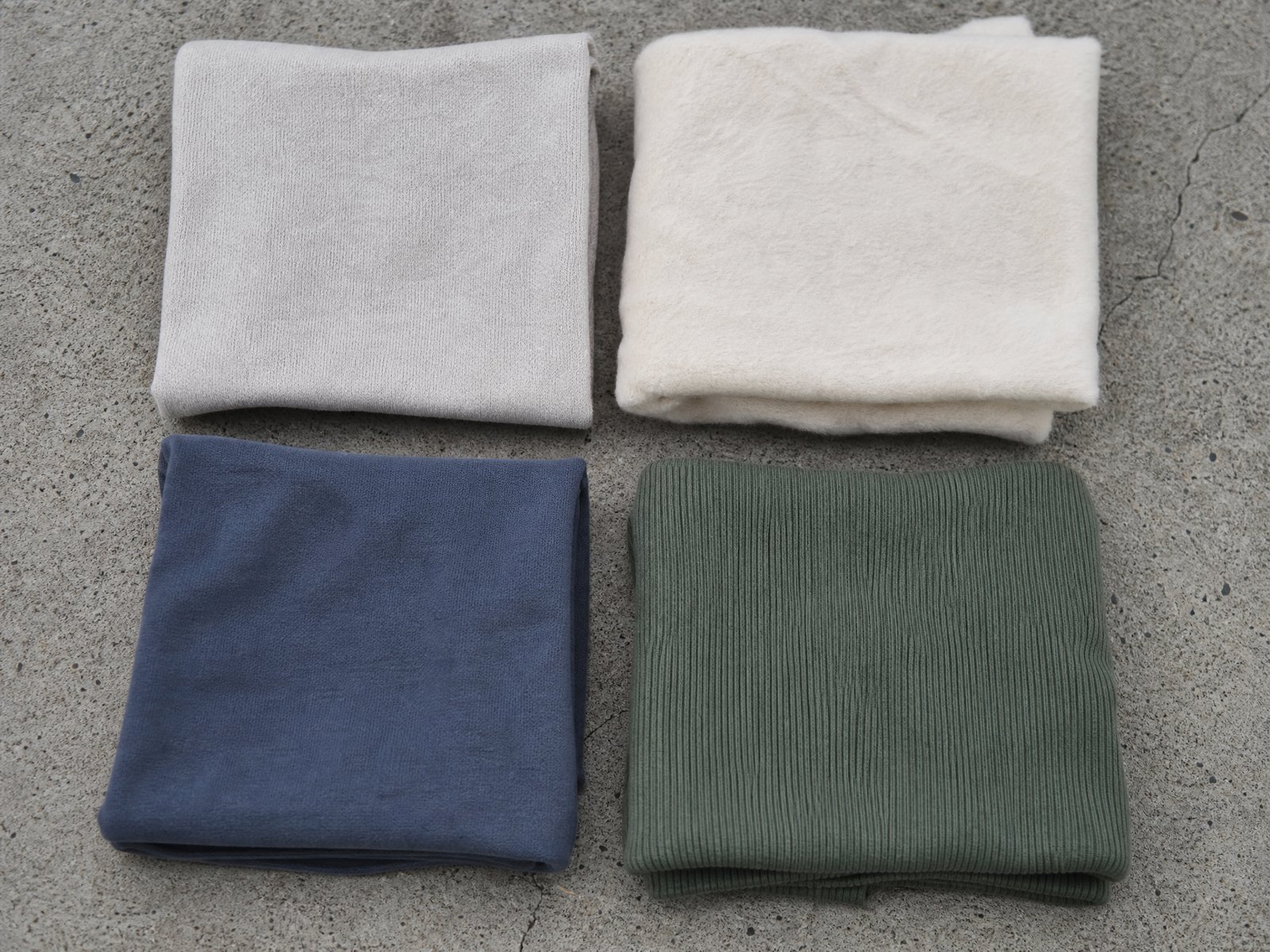
We buy a small number of fabrics and use them repeatedly, which is the only way to keep fit and colour consistent. Everything is knitted from combed, ring-spun organic cotton, with recycled polyester in some fleeces and a small share of elastane where a garment has to recover its shape. Below is what each one is, what it does well, and what it costs you in exchange.
Why combed ring-spun cotton
Ring spinning twists fibres into a continuous yarn, which makes it smoother and stronger than the cheaper open-end route. Combing then removes the short fibres and any remaining seed fragments before spinning. Short fibre ends are what work their way to the surface and roll into bobbles, so combed yarn pills noticeably less and feels softer against the skin. It is roughly a third more expensive per kilo, and it is the single biggest reason a £28 tee feels different from a £6 one.
The weights we use
- 180gsm single jersey — our standard tee fabric. Light, breathable, drapes rather than holds a shape. Single jersey is knitted on one needle bed, which makes it naturally curl at a raw edge; that is why every hem is twin-needle stitched and every neckline bound with rib.
- 220gsm heavy jersey — a denser tee that stands slightly away from the body and shows less through the shoulders. Warmer, slower to dry.
- 220-240gsm 2×2 rib — alternating raised wales that compress and spring back. Rib measures small flat and stretches a long way, which is what makes a tank sit close without a fastening.
- 300-340gsm loopback jersey — a three-thread knit with the loops left uncut on the inside. Loopback traps air, keeps a crisp outer face and holds its structure through years of washing. It is less immediately soft than fleece.
- 350-360gsm brushed-back fleece — the same construction with the loops mechanically brushed open. Much warmer and softer on day one, but the raised nap sheds a little and picks up more surface fuzz over time. Genuine trade-off, so we offer both.
- 240-280gsm interlock and compression knit — double-faced, smooth on both sides, stable and opaque. Used for support layers where a raw-looking inside face would be uncomfortable.
Organic cotton
Our cotton comes from certified organic sources in Turkey and Portugal, grown without synthetic pesticides or defoliants and processed without chlorine bleach. Practically, organic cotton is not softer than conventional cotton of the same staple length — anyone claiming that is selling you a story. What it changes is the growing and dyeing chemistry, and it costs us 15-25% more at yarn stage.
Recycled polyester and polyamide
We blend 12-20% recycled polyester into some fleeces because pure cotton fleece stretches out at the elbows and takes a long time to dry. Polyester adds dimensional stability and shortens drying time. The honest cost is microfibre shedding in the wash; a filter bag reduces it. Our compression knit uses recycled polyamide for the same reason — it recovers better than cotton under repeated load.
Elastane
Elastane appears at 5-12% in stretch jersey, stretch rib and support layers. It is what lets a band stay put and a fitted tee return to shape rather than bag at the elbow. It is also the shortest-lived fibre in the garment: heat, chlorine and oil degrade it, which is why we tell you never to tumble dry it. A cotton-elastane piece has a shorter working life than a pure cotton one, and we would rather say so than pretend.
Dyeing and the black-and-white palette
Solid colours are reactive dyed at piece stage, which bonds dye to the cellulose and gives deep, wash-fast blacks. Very dark shades can crock slightly on the first two wears — a little rub-off onto a pale bag strap. Wash before first wear if that matters to you. Grey marl is made by blending dyed and undyed fibre before spinning, so it varies more between lots than any solid. Chalk white is undyed and warms slightly with age; optic white is brightened and needs a brightener-free wash to stay even.
Trims and threads
Neck tape is self-fabric rather than woven binding, so nothing scratches. Sewing thread is a polyester core spun with cotton, because pure cotton thread breaks before the fabric does. Zips are metal with a flat pull and a chin garage. Care labels are printed on cotton tape. Full composition for each style sits on its product page; anything not listed there, ask us at support@wfxcu.shop or read more at https://wfxcu.shop/materials.
WFXC LTD
Company number 17269281, registered in England and Wales.
Registered office: 21 Cavendish Road, Chesham, HP5 1RW, England
Email: support@wfxcu.shop
WFXC LTD is not currently registered for VAT. No VAT is charged on the prices shown on this website.